
The Florida Company Offering Composite Blocks That Can Take On Wood, Steel and Concrete
RENCO – a Coastal Construction affiliate – has spent millions getting a Lego-style composite building system approved in the US. Lucy Dixon spoke to Ken Smuts, RENCO president, about how this sustainable building material could meet America’s housing demands.
US building codes recognise three structural materials: wood, steel and concrete. When the owner of one of Florida’s largest construction companies asked his engineer whether a fourth could be added, the answer was a flat no. He asked again anyway.
That exchange, on a flight home from Turkey, is how RENCO came to exist. The company is an affiliate of Coastal Construction, which builds around $2.5 billion a year of high-rise concrete projects, mostly condominiums, apartments and resorts. Its owner, Tom Murphy, had been introduced to a Turkish-American businessman who had developed what Ken describes as an interlocking composite block, with studs on top (hence the comparison to Lego), the same size as a concrete masonry unit at roughly 8 x 8 x 16 inches (20 x 20 x 40 cm).
Tom and Ken toured a newly built factory and a nearly finished five-storey, 75,000 sq ft office building made from the blocks. "We were blown away," Ken recalls. On the flight back, Tom said he wanted to do it in the United States.
Overcoming obstacles
The team expected two hurdles: approval and market acceptance, and budgeted about a million dollars and a year. "We were wrong on both counts," Ken says. Over 400 tests followed in ANSI-certified laboratories to ASTM standards, covering material properties, then connections, then full assemblies, plus fire, thermal and environmental testing. The reason for the thoroughness, he says, was to avoid exposing Coastal's core business to a start-up product with unresolved issues. Approval arrived in September 2019, just before COVID. The system is recognized under the International Building Code through IAPMO UES Evaluation Report ER-508 and holds Florida Building Code approval for use in the High-Velocity Hurricane Zone.
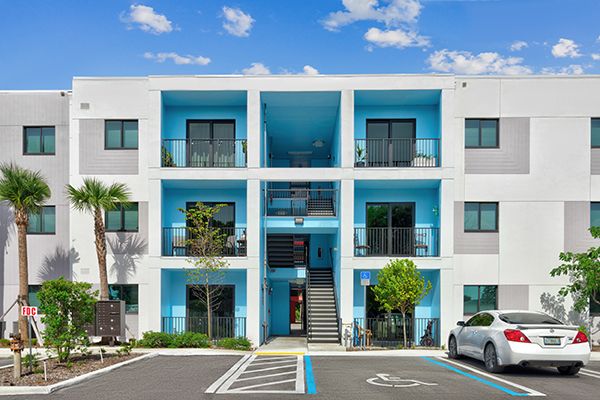
Acceptance was the next test. The team bought land, then designed a 96-unit, three-storey garden-style apartment scheme to prove the system to themselves before taking it to others. The project, Lakewood Villages, is now complete: each of its four three-story buildings was erected by just 11 workers in about eight weeks, saving roughly 20% of the time and cost of conventional hurricane-zone concrete construction.
COVID did pause the project for about a year, and then a second problem landed: with blocks shipped from Turkey, container costs rose from around $3,200 to about $15,000, wiping out the savings the product was meant to offer buyers.
The response was to manufacture domestically. A fully automated factory has now opened in Jupiter, in Palm Beach County, with capacity at full production of around 6,000 homes a year.
What's in the block?
The blocks are made from four main ingredients: a polyester resin, partly from repurposed PET plastic such as water bottles and partly virgin resin; calcite, or limestone dust, the same material used in making Portland cement; aluminium trihydrate as a fire retardant, which is what allows buildings above three storeys; and fibreglass, both repurposed and virgin. Chopped glass fibre goes into the blocks, which are made by bulk moulding. Joists, decking and bridging are made from continuous fibreglass mat and rovings using pultrusion.
The structure is simply supported: block walls go up first, and joists sit on top to carry the floor or roof above.
Build by numbers
The selling point to developers is speed and labour. Ken says that the blocks weigh about a fifth of a concrete block and are assembled with a mallet and a glue gun. Drawings, themselves produced with AI, are colour-coded so crews place each of the eight block sizes where the plan shows, with nothing to cut or measure on site. Joists and decking are precut at the factory, and no single element is heavier than two people can lift.
"Instead of paint by numbers, it's build by numbers," he says. A project can go up with unskilled labour and without heavy machinery.
On sustainability, the company commissioned a cradle-to-gate study, which found a carbon footprint far below reinforced concrete and structural steel. RENCO’s blocks and profiles also carry third-party endorsed Environmental Product Declarations.
The hurricane question
South Florida's wind zones are among the toughest anywhere. Category 5 storms bring winds of 157 mph or more, and Miami structures are designed for 185 mph. Ken says its block was tested to ultimate failure and gave way only above 240 mph, and that its strength is meant to keep the roof on if a window blows out.
Where it goes from here
The system has been used on more than 400 buildings in Turkey and the Middle East, from mosques and apartments to fire stations, warehouses and dog kennels. In the US, the company sees housing as the best fit. Of about 1.5 million annual housing starts, roughly 170,000 are in Florida, 160,000 in Texas and 140,000 in Arizona, which together make up about a third of the national total. The plan is to build factories in those three states.
Today there are around six live projects, split between Florida and Texas, and about 200 have been priced. With the factory running, the focus is on filling its order book for the year ahead. Ken points to data center construction as a source of demand: with facilities sited far from existing towns, the workforce building and operating them needs somewhere to live.