)
)
)
Turning Air Into Drinking Water: Could Atmospheric Water Generation Change Construction?
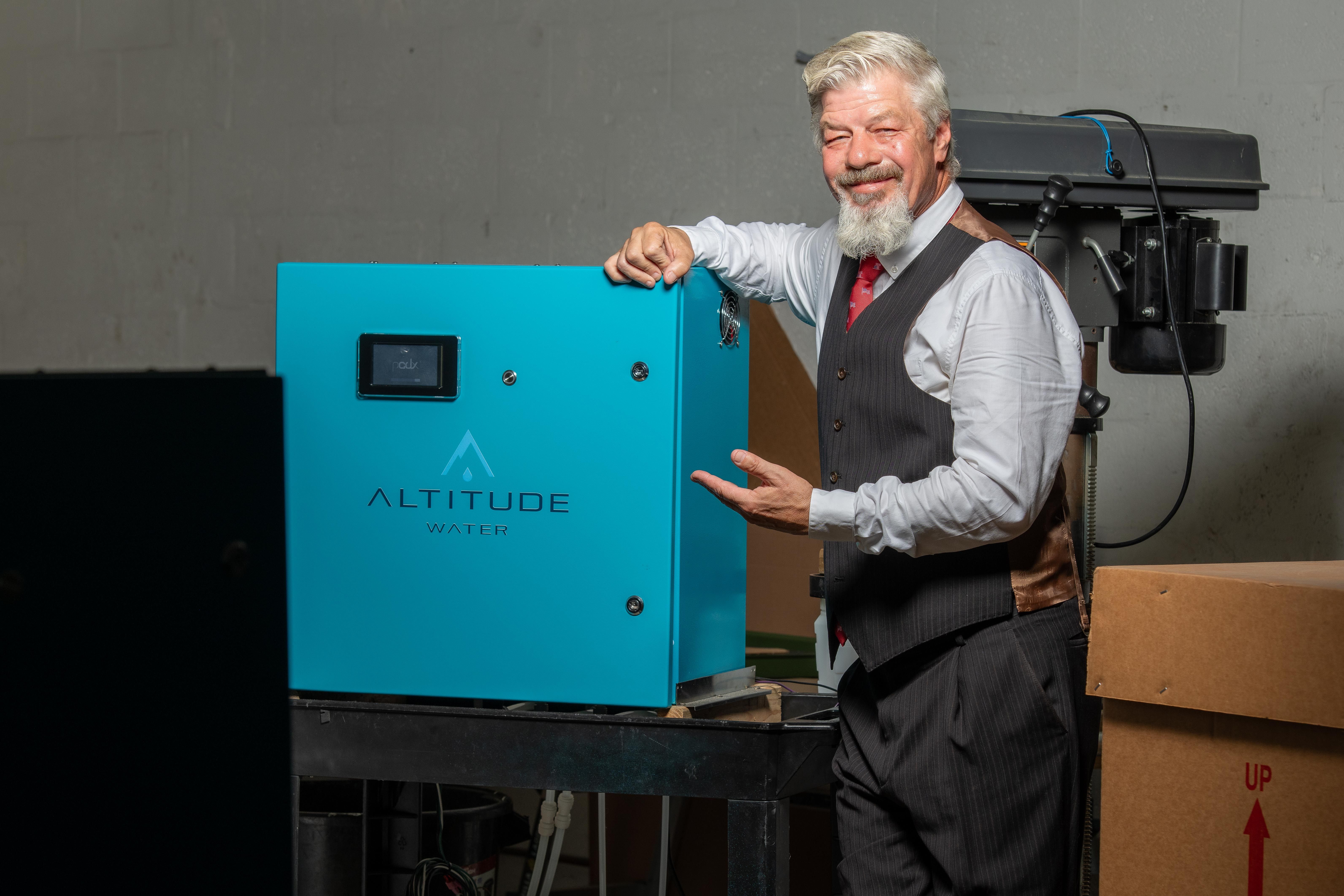
As water shortages become an increasing concern around the world, one company believes the answer could already be in the air. Lucy Dixon caught up with Altitude Water to find out how atmospheric water generators work – and why the technology could have applications across the construction industry.
Imagine arriving on site and producing your own drinking water without a mains connection, water deliveries or pallets of bottled water. That’s the promise behind atmospheric water generators (AWGs), a technology that extracts moisture from the air and converts it into drinking water.
According to Altitude Water, the process is surprisingly straightforward. “The atmosphere contains water vapour,” Jeff Szur, COO explains. “We capture that humidity and condense it into drinking water. Whenever water changes from a gas into a liquid, it’s naturally pure.”
Unlike traditional water supplies, which often require extensive filtration to remove contaminants, Altitude Water says its process starts with water that has never been exposed to groundwater pollutants. The company then uses a proprietary ozone purification system to keep both the water and the machine clean before adding minerals to create alkaline drinking water with a pH of around 8.1.
More than disaster reliefWhile the technology has obvious applications in disaster zones and remote locations, Altitude Water believes its potential market is much broader. The company points to hospitality, healthcare, offices and residential properties as sectors that could benefit, particularly as concerns grow around water security, chemical contamination and microplastics.
Construction is another area where the technology is proving useful. On development sites, AWGs could provide drinking water for workers without relying on bottled water deliveries or temporary water supplies. Altitude Water has also developed mobile disaster relief trailers that combine atmospheric water generation with solar power and satellite communications, creating self-contained units capable of providing electricity, drinking water and internet connectivity from almost anywhere.
For developers, Szur believes the technology could become part of future building design.
Integrating water generation into new developments
Rather than replacing mains water entirely, Altitude Water envisages atmospheric water generation becoming part of a hybrid water strategy.
The pure drinking water produced by the units could be supplied directly to kitchens, drinking fountains and refrigeration systems, while conventional or harvested water would continue to serve toilets, laundry and other non-potable applications.
“Using ultra-pure drinking water to flush toilets doesn’t make sense,” Szur explains.
For newbuild developments, integrating the system during construction offers significant advantages, allowing dedicated pipework to be installed from the outset. Retrofitting existing buildings is possible but inevitably more complex.
Water scarcity moves up the agendaAlthough atmospheric water generation has traditionally been associated with arid regions, Altitude Water says interest is growing rapidly in the UK – even before the most recent droughts declared across the country. Altitude, which operates in more than 75 countries, says enquiries from Britain have increased significantly as awareness of the technology spreads through social media and demonstration projects.
The UK’s naturally high humidity also makes it well suited to atmospheric water generation. Altitude Water believes changing attitudes towards water security are driving demand, with droughts, ageing infrastructure and increasing pressure on water resources encouraging organisations to explore alternative solutions.
The company also argues that rising demand from large AI data centres, alongside population growth and climate pressures, is placing additional strain on freshwater supplies in many regions.
Reducing bottled water on siteFor contractors, one of the biggest attractions could be reducing dependence on bottled water. Instead of arranging deliveries throughout a project, a self-contained atmospheric water generator could continuously produce drinking water wherever adequate humidity and power are available.
Altitude Water estimates the cost of producing water ranges from around two to 15 cents per litre, depending largely on atmospheric conditions and energy costs. Systems powered by solar energy could reduce operating costs further. Szur says customers typically achieve a return on investment within two to three years, while the equipment itself is designed to last between 10 and 15 years.
A technology still unfamiliar to manyDespite operating for almost two decades, atmospheric water generation remains relatively unknown. Altitude Water says international polling suggests around 70% of people have never heard of the technology, something it sees as one of the industry’s biggest challenges – awareness is now increasing as concerns around water resilience continue to grow.
For construction, the concept raises interesting possibilities.
Whether providing drinking water on remote construction sites, supporting off-grid developments or becoming part of future sustainable building design, atmospheric water generation could represent another tool in the industry’s drive towards greater resilience and self-sufficiency.
As pressure on water resources increases, technologies that once seemed futuristic may soon become a more familiar sight on construction projects.
)
)
)
)
)